Does Creatine Cause Hair Loss? Separating Myth From Science
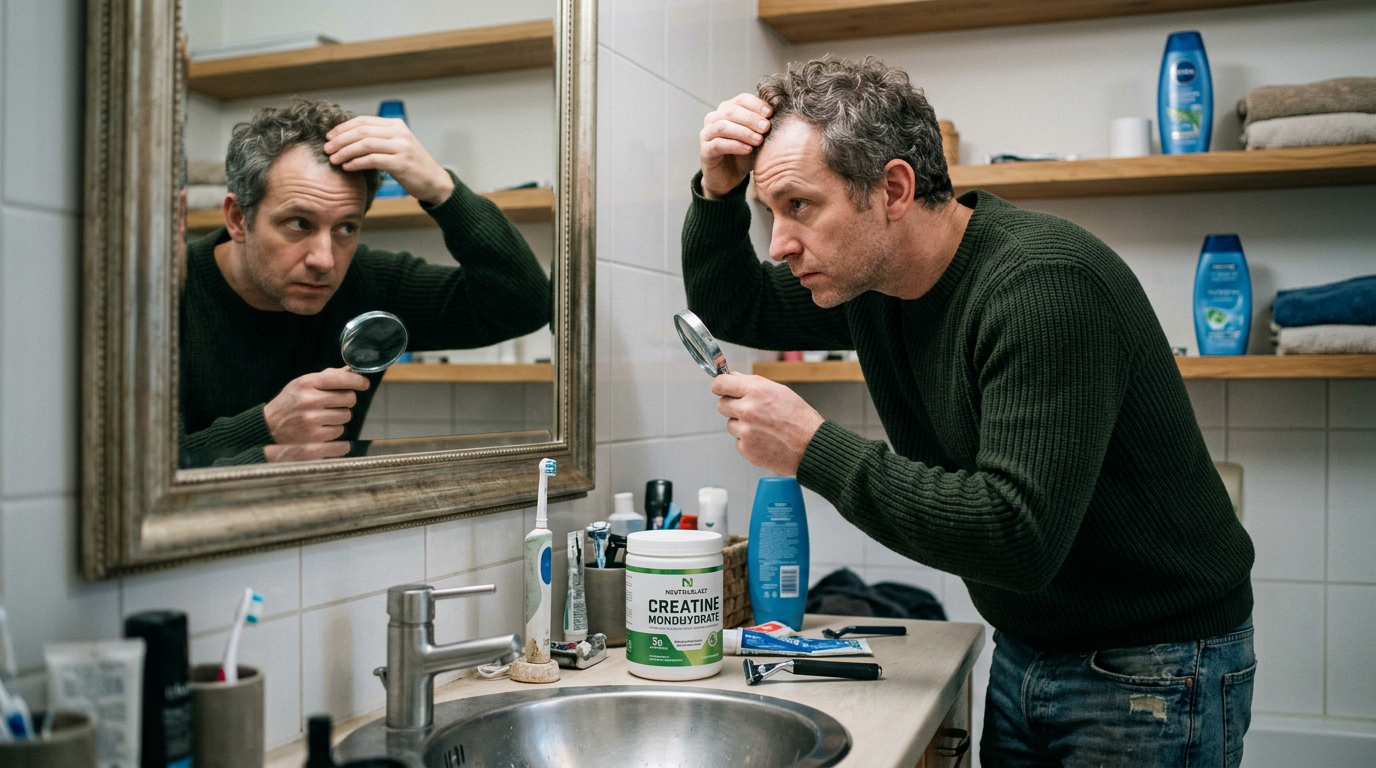
It's the single most common reason people quit—or never start—creatine. The fear is everywhere on gym forums, TikTok, and Reddit. But when you trace the claim back to its source, the entire concern rests on one 2009 study of 20 college rugby players. Here's what the research actually shows.
The Origin of the Myth
In 2009, van der Merwe and colleagues published a small trial in Clinical Journal of Sport Medicine giving 20 rugby players either creatine or placebo for three weeks. After a 7-day loading phase (25 g/day), the creatine group showed a 56% increase in DHT (dihydrotestosterone)—a hormone linked to male pattern baldness. After dropping to 5 g/day maintenance, DHT remained ~40% above baseline.
Critical context: every measured value stayed inside the normal physiological reference range, and the study never measured hair loss. Not a single hair was counted.
What 15+ Years of Follow-Up Research Shows
Since 2009, no study has replicated the DHT finding at standard maintenance doses. The 2021 International Society of Sports Nutrition position stand—reviewing 685+ creatine studies—concluded there is no compelling evidence that creatine causes hair loss or affects hair follicles.
A 2023 meta-analysis examined testosterone, free testosterone, and DHT across 12 randomized trials. Result: no significant effect on any androgen at standard dosing protocols.
Why the Myth Persists
- Timing coincidence: Men who start creatine in their 20s are entering peak years for androgenetic alopecia onset—correlation, not causation.
- Water weight on the scalp: Creatine increases intracellular water. Some users misinterpret slight changes in hair appearance as thinning.
- Confirmation bias: One viral anecdote outperforms a dozen meta-analyses on social media.
If You Have Genetic Hair Loss Concerns
Androgenetic alopecia is a real, heritable condition. While creatine has not been shown to cause it, men with strong family history may want to take these precautions:
- Skip the loading phase—go straight to 3–5 g/day.
- Stick to creatine monohydrate (the most-studied form).
- If you notice changes, see a dermatologist for trichoscopy—don't blame supplements without evidence.
The Bottom Line
Creatine monohydrate is the most researched sports supplement in history. The hair loss claim rests on one unreplicated study that never measured hair. The benefits—strength, power, cognition, recovery—are overwhelming and well-documented. If you've been avoiding creatine over hair concerns, the evidence does not support the fear.
Frequently Asked Questions
- Does creatine cause hair loss?
- No direct evidence. The hair loss claim traces to a single 2009 rugby player study showing a DHT increase that stayed within normal physiological range. No subsequent study has replicated that finding, and no study has ever directly measured hair loss from creatine supplementation.
- Does creatine raise DHT?
- The 2009 study showed a 56% rise in DHT after a 7-day loading phase, settling at 40% above baseline—but values remained inside the normal lab range. Multiple follow-up studies have failed to reproduce the DHT effect at maintenance doses of 3–5 g/day.
- Should men with male pattern baldness avoid creatine?
- If you carry genetic sensitivity to DHT (androgenetic alopecia), the theoretical risk is non-zero but unproven. Most dermatologists do not list creatine as a contraindication. If concerned, stick to 3–5 g/day, skip loading phases, and monitor.
- Are there hair-safe alternatives to creatine monohydrate?
- There is no evidence other creatine forms (HCl, ethyl ester, buffered) behave differently regarding DHT—and monohydrate remains the only form with hundreds of validated efficacy and safety studies.
- What does the ISSN say about creatine and hair loss?
- The International Society of Sports Nutrition's position stand (2021) explicitly states there is no compelling scientific evidence that creatine supplementation causes hair loss or affects the hair follicle.