Creatine HCL vs Monohydrate: What the Research Actually Says
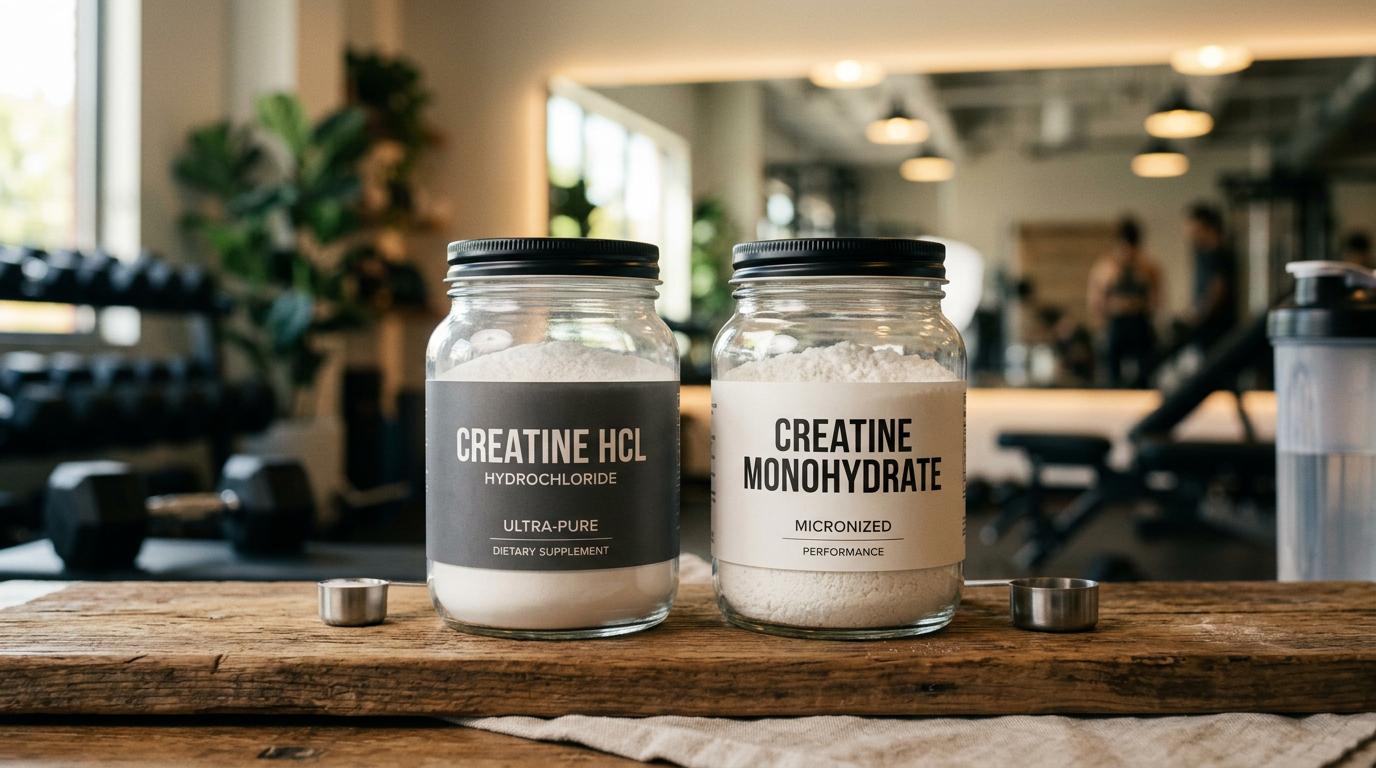
Creatine HCL is sold on three promises: better solubility, no bloat, lower effective dose. Two of those are partly true, one isn't. None of them justify the price gap over monohydrate.
The Solubility Claim
Creatine HCL does dissolve more readily in water — a hydrochloride salt always will. If you've ever had grit at the bottom of a monohydrate shake, HCL avoids that. But monohydrate bioavailability is already ~99% regardless of how cloudy the glass looks. Better solubility ≠ better absorption.
The "Lower Dose" Myth
HCL brands often recommend 1–2 g/day. The problem: muscle creatine saturation requires loading 5 g/day for ~3 weeks or 20 g/day for 5–7 days — regardless of form. The HCL molecule is just creatine bonded to a hydrochloride salt; you still need the same amount of creatine itself reaching the muscle. Under-dose and you'll under-saturate.
The Bloat Question
The "bloat" critics blame on creatine is intramuscular water retention — and it's the entire point. Creatine pulls water into muscle cells, which is part of why it improves performance. That happens with both forms. Some users do report less GI discomfort with HCL, likely from improved solubility — but not less water weight.
Head-to-Head Studies
A 2015 study compared 5 g HCL vs 5 g monohydrate over 28 days and found no meaningful difference in performance or body composition. Subsequent comparisons have reached similar conclusions. The form that has 700+ studies behind it is monohydrate.
Cost
Monohydrate: about $0.05–$0.10 per 5 g serving. HCL: often $0.40–$0.80 per equivalent dose. Five to ten times the cost for an ingredient with no demonstrated advantage.
Who HCL Makes Sense For
Two narrow cases: users who consistently get GI upset from monohydrate (rare but real), and travelers prioritizing a compact mixable form. Everyone else: monohydrate.
The Bottom Line
Creatine monohydrate, 5 g/day, micronized for better mixing. It's the most-studied performance supplement in history, and it costs less than a cup of coffee per month.
Frequently Asked Questions
- Is creatine HCL better absorbed than monohydrate?
- It dissolves more in water — that's it. Bioavailability of monohydrate is already ~99%. There is no absorption problem to solve.
- Do I need a lower dose of HCL?
- No. The 'micro-dose' claim is marketing. Muscle creatine saturation requires the same amount of creatine the molecule delivers — HCL is just creatine + hydrochloride salt.
- Will HCL stop the bloat?
- Some users report less GI discomfort, which may relate to better solubility. The water-weight 'bloat' is intramuscular and happens with both forms — that's the point of creatine.
- Cost comparison?
- Monohydrate runs $0.05–$0.10 per 5 g serving. HCL is often 5–10× the cost per equivalent dose of creatine. There is no performance data justifying the price gap.