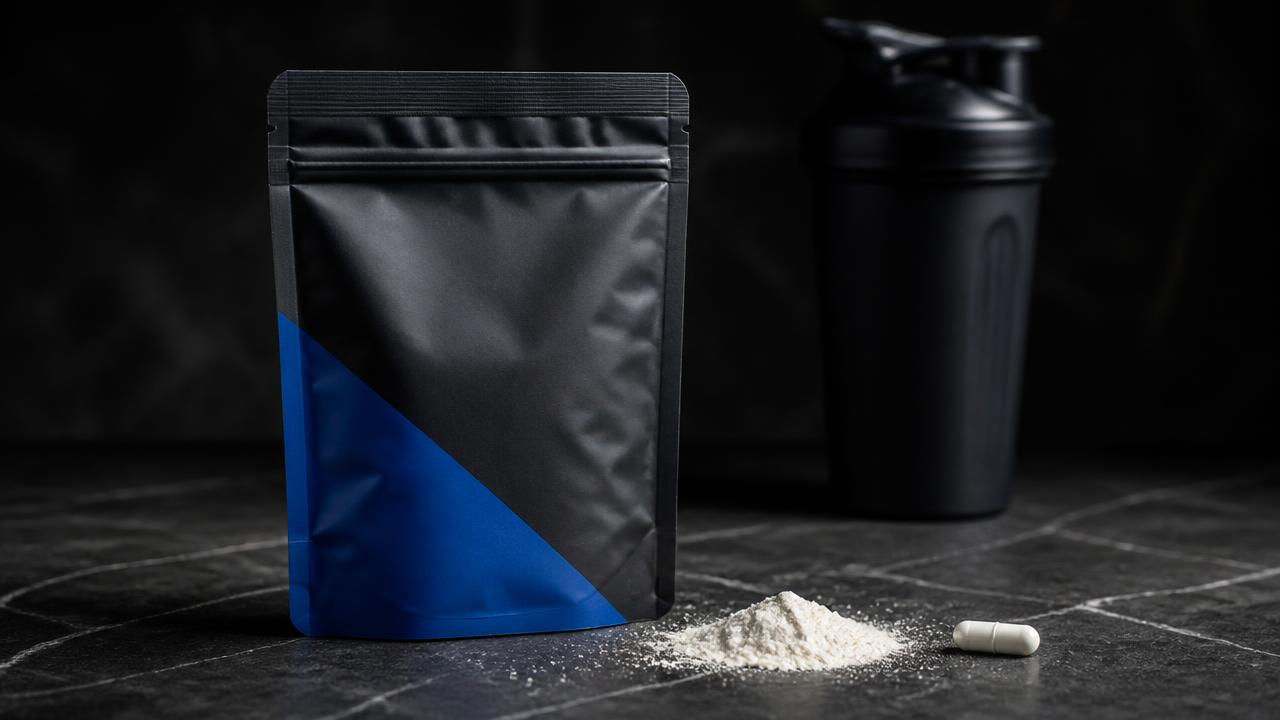
Replace Those Heavy Bottles: Inside Arranti's Mini-Me Pouch
Pick up a bottle of capsules and weigh it in your hand. Then imagine removing the bottle. What remains — the actual product a customer paid for — is a fraction of what you just shipped, warehoused, and stacked on a shelf. The rest is plastic, air, a desiccant pack and a cap.
Arranti built the Mini-Me pouch around that observation. Its tagline is blunt: replace those heavy bottles.
A Small Format That Doesn't Look Small
The Mini-Me is a miniature flat-bottom stand-up pouch — the same structure as Arranti's full-size protein pouches, scaled down — engineered for small-format supplements — capsules, tablets, softgels, single-serve powders and sample portions. What sets it apart from a generic sachet is presence. Side gussets add capacity and structure, the flat bottom stands it square on shelf, and it gives the brand a genuine 360-degree canvas rather than a floppy front panel.
Bold 360° graphics, premium shelf impact, and durable, sustainable packaging that stands out in any category.
Arranti prints these with vivid multi-color process work, matte and gloss finishes and metallic accents. A small pack with a soft-touch matte body and a foiled logo reads as more expensive than a stock bottle with a paper label — and it costs less to produce and move.
Barrier First, Aesthetics Second
The reason bottles persisted in the supplement category was protection, not beauty. Capsules absorb moisture. Botanicals oxidise. Colours fade under retail lighting. Any format replacing a bottle has to solve that first.
Arranti specifies premium high-barrier multilayer laminates for the Mini-Me, layering moisture, oxygen and UV protection into the structure itself. Combined with press-to-close zippers and tear notches, the pack stays sealed and stable across a full 30, 60 or 90 day supply — the same film discipline behind the heavy-duty formats we covered in Arranti's packaging testing regime.
The Economics Are Not Subtle
- Material: grams of film instead of tens of grams of rigid HDPE plus cap, induction seal, desiccant and label.
- Inbound freight: empty pouches ship flat and nest; empty bottles ship air.
- Outbound freight: lower weight and smaller cube on every DTC parcel, where dimensional weight quietly eats margin.
- Storage: more finished units per pallet position, less warehouse rent per SKU.
- Tooling: no bottle mould, no cap sourcing, no minimum-order bottle run sitting in a corner for two years.
For a brand running fifteen capsule SKUs, that last point is often the decisive one. Flexible formats let you launch a variant without committing to rigid tooling — which is what makes small-batch, seasonal and limited-edition products viable.
Built for How People Actually Use Supplements
Consumers travel. They keep a pack in a gym bag, a desk drawer, a glove box. A rigid bottle rattles, takes up volume and cracks. A Mini-Me pouch flattens as it empties, doesn't announce itself in a carry-on, and reseals cleanly. Hang holes make it retail-ready on a peg; tear notches make the first open effortless.
That portability is also a sustainability story consumers can actually see. "We removed the plastic bottle" needs no explanation on a shelf talker.
Where It Fits Best
The Mini-Me earns its place for capsule and tablet supplements, creatine and collagen single-serves, electrolyte and hydration portions, sleep and nootropic stacks, sample and trial programs, and subscription refill packs shipped alongside a reusable jar. Brands frequently run a hybrid: a premium refillable container at first purchase, Mini-Me refills forever after.
Making the Switch
Moving off bottles is less disruptive than most brands expect. Arranti works backwards from the dosage form, fill weight, shelf-life target and retail channel, then specifies film, size, closure and finish. Print runs up to 10 colors, and the finished packaging can land in as little as five weeks.
If you're paying to ship air, there's a smaller, stronger, better-looking way to do it.
Frequently Asked Questions
- Can capsules and tablets really ship in a pouch?
- Yes. High-barrier multilayer film blocks moisture, oxygen and UV as effectively as an HDPE bottle with a desiccant, and a press-to-close zipper keeps the pack resealable across a 30 to 90 day supply.
- How much shipping cost does a pouch actually save?
- A flexible pouch weighs a fraction of a rigid bottle and ships flat before filling. Brands typically see meaningful reductions in both dimensional weight and pallet count, with the biggest gains on direct-to-consumer parcels.
- Does the Mini-Me pouch work for sample and trial sizes?
- It is one of its strongest use cases. Sample portions, travel packs, subscription refills and trial SKUs all benefit from a format that looks premium at small volumes without bottle tooling.