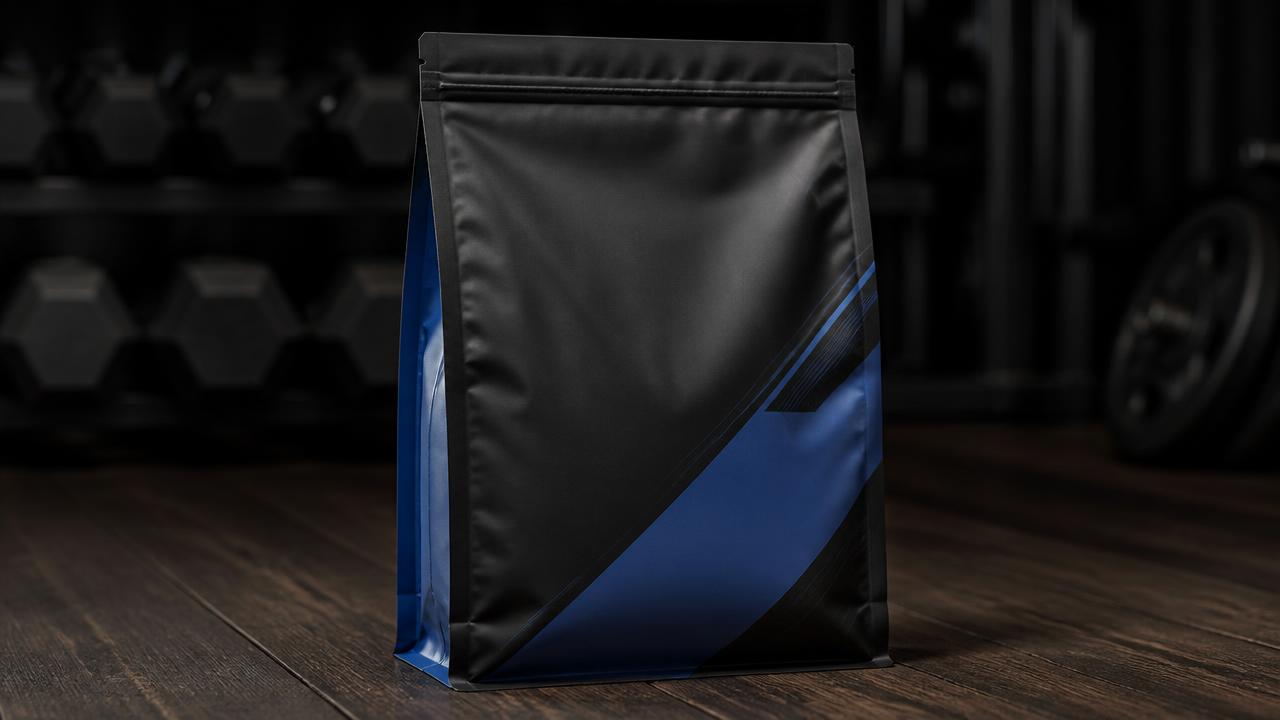
Five Sides of Design: How Arranti's Flat Bottom Pouches Win the Shelf
Walk any supplement aisle and you can spot the difference instantly. Some packs slump. Some lean. Some quietly turn sideways over the course of a busy Saturday until the logo is facing the wall. And then there are the packs that stand square, shoulders back, block-solid — the ones that look like they were engineered rather than merely filled.
That's the flat bottom pouch. And it's one of the formats Arranti has spent years refining for sports nutrition brands that need strength and shelf presence in the same package.
Five Panels Instead of Two
A standard stand-up pouch gives you a front and a back. A flat bottom pouch gives you five printable surfaces: front, back, both side gussets and the base. For a brand, that isn't a design detail — it's inventory. Side gussets become certification badges, amino acid profiles, usage protocols and QR codes. The base becomes lot coding and traceability. The front stays clean and confident because the supporting information finally has somewhere to live.
"Branded ROI on 5 panels" is how Arranti frames it — every square inch of film is either selling or informing.
That matters most in categories where the buying decision happens at the shelf in under six seconds. Protein, greens, pre-workout, collagen and functional coffee are all crowded, and a pack that can carry its full story without looking cluttered wins the pick-up.
Stability Is a Sales Feature
The flat, rigid base is what separates this format from everything else in flexible packaging. A properly engineered flat bottom pouch stands like a carton but flexes like a pouch. It doesn't tip when a customer pulls the pack next to it. It stacks cleanly in a warehouse. It merchandises face-out in a display without a shelf tray propping it up.
Arranti tunes that stability to the fill weight. A 2 lb greens powder and a 10 lb bulk protein behave completely differently — headspace, height-to-width ratio and gusset depth all get dialled in so the finished, filled pouch sits square instead of bulging into a barrel shape.
More Volume, Less Material
The geometry is efficient. A flat bottom structure holds more product per gram of film than a comparable pillow or standard stand-up pouch, which means lower material cost, lower shipping weight, and a smaller footprint on the pallet. For brands publishing sustainability targets, the swap from rigid tub to flat bottom pouch is one of the largest single reductions available without reformulating anything.
It also shows up in freight. Empty pouches ship flat and nest; empty tubs ship air. Brands moving containers of packaging across borders feel that difference immediately — which is exactly the kind of landed-cost math we covered in Arranti's tariff-stable landed cost approach.
Barrier Performance Under the Print
None of the shelf theatre matters if the product inside degrades. Arranti builds flat bottom pouches on high-barrier multilayer laminates chosen for the specific fill: hygroscopic powders that clump at the first hint of moisture, oil-rich blends that oxidise, botanicals that fade under UV, and freshly roasted contents that need a one-way degassing valve.
Closures follow the same logic. Press-to-close zippers for daily-use powders. Pocket sliders for premium positioning. Velcro and tin ties where a consumer needs a confident, tactile reseal. Tear notches so the first open doesn't require scissors — the small moment that quietly determines whether someone repurchases.
Security Printed Into the Pack
Arranti prints variable, serialized QR security codes inline across its pouch formats. Every unit can carry a unique code tied to batch, expiry and authenticity records — a defence against the counterfeit and diverted-goods problem that has followed high-value supplements onto global marketplaces. It's also the on-ramp to the 2D barcode transition arriving with GS1 Sunrise 2027.
Who Should Be Using This Format
Flat bottom pouches earn their keep for protein powders and mass gainers, greens and reds blends, functional coffee and creamers, pet nutrition, meal replacements, and any SKU where the brand wants to look premium without paying for a rigid container. They are equally strong in bulk club-store sizes and in tight 1–2 lb formats that need to punch above their footprint.
If your current pack is a tub you inherited from a co-man, or a pillow bag that keeps face-planting on shelf, the format change alone is often worth more than a redesign.
Start With the Product, Not the Bag
Arranti's process runs backwards from the fill: what's the product, what kills it, how heavy is it, how is it shipped, where does it sit at retail. Film structure, panel layout, closure and shipper configuration all fall out of those answers — and then it gets printed, up to 10-color rotogravure, and delivered in as little as five weeks.
Tell us what you're making and we'll show you what five panels can do for it.
Frequently Asked Questions
- How many printable panels does a flat bottom pouch have?
- Five — front, back, two gussets and the bottom. That gives brands roughly 60% more branded surface than a comparable pillow pouch, plus a stable base that keeps the pack facing forward on shelf.
- What closures can Arranti add to a flat bottom pouch?
- Press-to-close zippers, Velcro closures, pocket sliders and tin ties, plus tear notches, hang holes and one-way degassing valves for freshly roasted or gas-releasing contents.
- Are flat bottom pouches cheaper than tubs?
- Almost always. They hold more volume with less material, ship flat before filling, cube out far better on a pallet and cut both freight and secondary packaging cost versus rigid HDPE tubs.